
5.5. Some frequentist connections#
Note
See also Frequentist hypothesis testing in Chapter 14.
\(\chi^2\)/dof for model assessment and comparison#
Many physicists learn to judge whether a fit of a model to data is good or to pick out the best fitting model among several by evaluating the \(\chi^2\)/dof (dof = “degrees of freedom”) for a given model and comparing the result to one. Here \(\chi^2\) is the sum of the squares of the residuals (data minus model predictions) divided by variance of the error at each point:
where \(y_i\) is the \(i^{\text th}\) data point, \(f(x_i;\hat\pars)\) is the prediction of the model for that point using the best fit for the parameters, \(\hat\pars\), and \(\sigma_i\) is the error bar for that data point. The degrees-of-freedom (dof), often denoted by \(\nu\), is the number of data points minus number of fitted parameters:
The rule of thumb is generally that \(\chi^2/\text{dof} \gg 1\) means a poor fit and \(\chi^2/\text{dof} < 1\) indicates overfitting. Where does this come from and under what conditions is it a statistically valid thing to analyze fit models this way? (Note that in contrast to the Bayesian evidence, we are not assessing the model in general, but a particular fit to the model identified by \(\hat\pars\).)
Underlying this use of \(\chi^2\)/dof is a special case of the familiar statistical model
in which the theory is \(y_{\text{th},i} = f(x_i;\hat\pars)\), the experimental error is independent Gaussian distributed noise with mean zero and standard deviation \(\sigma_i\), that is \(\delta y_{\text{expt}} \sim \mathcal{N}(0,\Sigma)\) with \(\Sigma_{ij} = \sigma_i^2 \delta_{ij}\), and \(\delta y_{\text{th}}\) is neglected (i.e., no model discrepancy is included). As a consequence
The likelihood (and the posterior, with an implicitly assumed uniform prior) is then proportional to \(e^{-\chi^2(\hat\pars)/2}\).
According to this model, each term in \(\chi^2\) before being squared is a draw from a standard normal distribution. In this context, “standard” means that the distribution has mean zero and variance 1. This is exactly what happens when we take as the random variables \(\bigl(y_i - f(x_i;\hat\pars)\bigr)/\sigma_i\). But the sum of the squares of \(k\) independent standard normal random variables has a known distribution, called the \(\chi^2\) distribution with \(k\) degrees of freedom. So the sum of the normalized residuals squared should be distributed (if you generated many sets of them) as a \(\chi^2\) distribution. How many degrees of freedom? This should be the number of independent pieces of information. But we have found the fitted parameters \(\hat\pars\) by minimizing \(\chi^2\), i.e., by setting \(\partial \chi^2(\pars)/\partial \theta_j\) for \(j = 1,\ldots,N_{\text{fit parameters}}\), which means \(N_{\text{fit parameters}}\) constraints. Therefore the number of dofs is given by \(\nu = N_{\text{data}} - N_{\text{fit parameters}}\).
Now what do we do with this information? We only have one draw from the (supposed) \(\chi^2\) distribution. But if that distribution is narrow, we should be close to the mean. The mean of a \(\chi^2\) distribution with \(k = \nu\) dofs is \(\nu\), with variance \(2\nu\). So if we’ve got a good fit (and our statistical model is valid), then \(\chi^2/\nu\) should be close to one. If it is much larger, than the conditions are not satisfied, so the model doesn’t work. If it is smaller, than the failure implies that the residuals are too small, meaning overfitting.
But we should expect fluctuations, i.e., we shouldn’t always get the mean (or the mode, which is \(\nu - 2\) for \(\nu\geq 0\)). If \(\nu\) is large enough, then the distribution is approximately Gaussian and we can use the standard deviation / dof or \(\sqrt{2\nu}/\nu = \sqrt{2/\nu}\) as an expected width around one. One might use two or three times \(\sigma\) as a range to consider. If there are 1000 data points, then \(\sigma \approx 0.045\), so \(0.91 \leq \chi^2/{\rm dof} \leq 1.09\) would be an acceptable range at the 95% confidence level (\(2\sigma\)). With fewer data points this range grows significantly. So in making the comparison of \(\chi^2/\nu\) to one, be sure to take into account the width of the distribution, i.e., consider \(\pm \sqrt{2/\nu}\) roughly. For a small number of data points, do a better analysis!
What can go wrong? Lots! See “Do’s and Don’ts of reduced chi-squared” for a thorough discussion. But we’ve made assumptions that might not hold: that the data is Gaussian distributed and independent, that the data is dominated by experimental and not theoretical errors, and that the constraints from fitting are linearly independent. We’ve also assumed a lot of data and we’ve ignored informative (or, more precisely, non-uniform) priors.
Test the sum of normal variables squared#
The \(\chi^2\) distribution is supposed to result from the sum of the squares of Gaussian random variables. Here we test it numerically for two values of the degrees of freedom (dof). (You can try other cases by copying the code into a Jupyter notebook.) The Gaussian (normal) random variables are drawn from a standard normal distribution, i.e., with mean \(\mu = 0\) and \(\sigma = 1\).
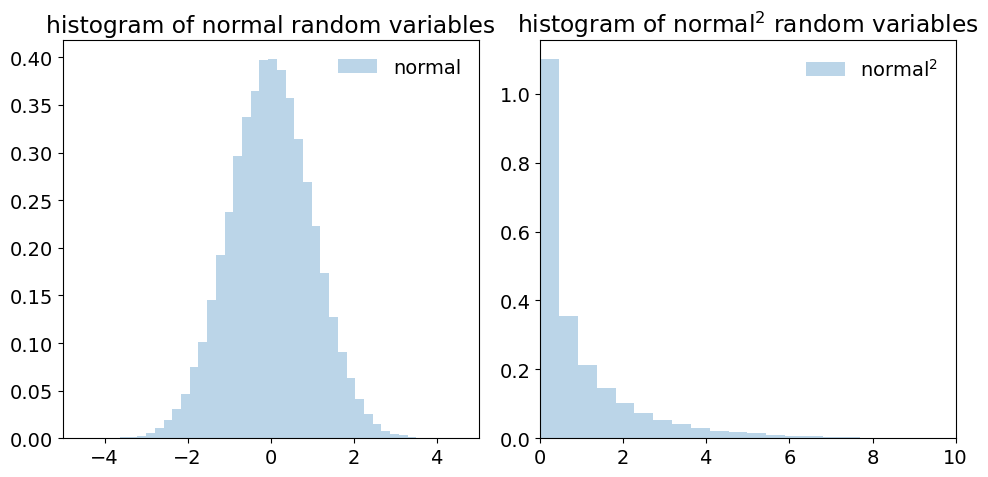
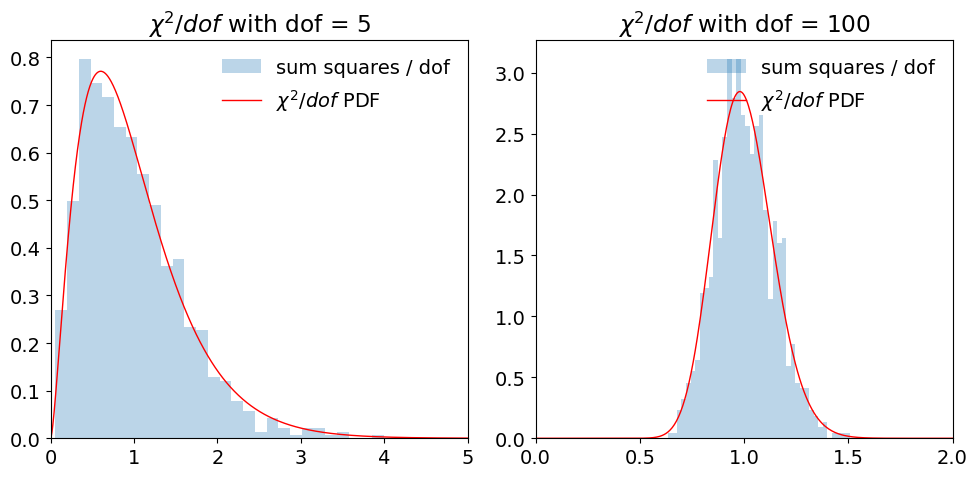
Check whether the distributions (which are of \(\chi^2/\nu\)) are consistent with the statement above that the mean of a \(\chi^2\) distribution with \(k = \nu\) dofs is \(\nu\), with variance \(2\nu\).
p-values: when all you can do is falsify#
A common way for a frequentist to discuss a theory/model, or put a bound on a parameter value, is to quote a p-value. This is set up using something called the null hypothesis. Somewhat perversely you should pick the null hypothesis to be the opposite of what you want to prove. So if you want to discover the Higgs boson, the null hypothesis is that the Higgs boson does not exist.
Then you pick a level of proof you are comfortable with. For the Higgs boson (and for many other particle physics experiments) it is “5 sigma’’. How do you think we convert this statement to a probability? [Hint: refer to a Gaussian distribution.] One minus the resulting probability is called the \(p\)-value. We will denote it \(p_\mathrm{crit}\). There is nothing God-given about it. It is a standard (like “beyond a reasonable doubt”) that has been agreed upon in a research community for determining that something is (likely) going on.
You then take data and compute \(p(D|{\rm null~hypothesis})\). If \(p(D|{\rm null~ hypothesis}) < p_{\rm crit}\) then you conclude that the “the null hypothesis is rejected at the \(p_{\rm crit}\) significance level’’. Note that if \(p(D|{\rm null~hypothesis}) > p_{\rm crit}\) you cannot conclude that the null hypothesis is true. It just means “no effect was observed”.
Exercise
Look at Demo: Widgetized coin tossing. Pick a \(p_{\rm crit}\)-value. If \(p_h=0.4\), work out how many coin tosses it would take to reject the null hypothesis that it’s a fair coin (\(p_h=0.5\)) at this significance level.
Contrast Bayesian and significance analyses for coin flipping#
Suppose we do a coin flipping experiment where we toss a coin 20 times and it comes up heads 14 times. Let’s compare how we might analyze this with Bayesian methods to how we might do a significance analysis with p-values.
Bayesian analysis. Following our study in Demo: Widgetized coin tossing, let’s calculate the probability of heads, which we call \(p_h\), given data \(D = \{R \text{ heads}, N \text{ tosses}\}\).
Let’s assume a uniform prior (encoded as a beta function with \(\alpha=1\), \(\beta=1\)).
We found that this can be expressed as a beta function, which we can calculate in Python using \(p(p_h|D) = p(D|p_h)p(p_h)\) \(\longrightarrow\)
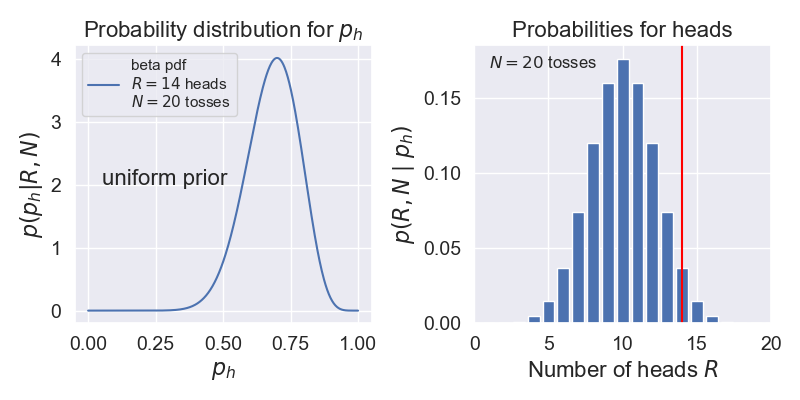
scipy.stats.beta.pdf(p_h,1+R,1+N-R). For \(N=20\), \(R=14\), this is shown on the left below.Now we can answer many questions, such as: what is the probability that \(p_h\) is between \(0.49\) and \(0.51\)? The answer comes from integrating our PDF over this interval (i.e., the area under the curve).
Note that in the Bayesian analysis, the data is given while the probability of heads is a random value.
Significance test. Here we will try to answer the question: Is the coin fair? We’ll follow the discussion in Wikipedia under p-value titled “Testing the fairness of a coin”.
We interpret “fair” as meaning \(p_h = 0.5\). Our null hypothesis is that the coin is fair and \(p_h = 0.5\).
We plot the probabilities for getting \(R\) heads in \(N=20\) tosses using the binomial probability mass distribution on the right above.
We decide on the significance \(p_{\rm crit} = 0.05\).
Important conceptual question
\(p_{\rm crit}\) and \(p_h\) are both probabilities. Explain what they are the probabilities of and how they are different.
We need to find the probability of getting data at least as extreme as \(D = \{R \text{ heads}, N \text{ tosses}\}\). For our example, that means adding up the binomial probabilities for \(R = 14, 15, \ldots, 20\), which is 0.058. (This is called a “one-tailed test”. If we wanted to consider deviations favoring tails as well, we would would add as well the probabilities for \(R = 0, 1, \ldots, 6\), so \(0.115\) in total. This would be a “two-tailed test”.) Comparing to \(p_{\rm crit} = 0.05\), we find the p-value is greater than \(p_{\rm crit}\), so the null hypothesis is not rejected at the 95% level. (Note that we say “not rejected” as opposed to “accepted”.) If we had gotten 15 heads instead we would have rejected the null hypothesis. We emphasize that in this frequentist analysis, the data is random while \(p_h\) is fixed (although unknown).
Exercise
Verify that if we had gotten 15 heads in \(N=20\) tosses that we would have rejected the null hypothesis.
Bayesian credible intervals and frequentist confidence intervals#
We already commented on the difference between the 68% degree of belief interval for the most likely value (in that case the bias weighting of the coin) and a frequentist \(1 \sigma\) confidence interval. Here are some additional comments.
The first point is that \(1 \sigma=68\)% assumes a Gaussian distribution around the maximum of the posterior (cf. above). While this will often work out okay, it may not. And, as we seek to translate \(n \sigma\) intervals into DoB statements, assuming a Gaussian becomes more and more questionable the higher \(n\) is. (Why?)
But the second point is more philosophical (meta-statistical?). One interval is a statement about \(p(x|D,I)\), while the other is a statement about \(p(D|x,I)\). (Note that because the conversion between the two PDFs requires the use of Bayes’ theorem, the Bayesian interval may be affected by the choice of the prior.)
The Bayesian version of a confidence interval is easy; a 68% credible interval or degree-of-belief (DoB) interval is: given some data and some information \(I\), there is a 68% chance (probability) that the interval contains the true parameter.
On the other hand, the frequentist 68% confidence interval is trickier: assuming the model (contained in \(I\)) and the value of the parameter \(x\), then if we do the experiment a large number of times then 68% of them will produce data in that interval. So the parameter is fixed (no PDF) and the confidence interval is a statement about data. Frequentists will try to make statements about parameters, but they end up a bit tangled, e.g., “There is a 68% probability that when I compute a confidence interval from data of this sort that the true value of \(\theta\) will fall within the (hypothetical) space of observations.”
For a one-dimensional posterior that is symmetric, it is clear how to define the \(d\%\) confidence interval. The algorithm is: start from the center, step outward on both sides, stop when \(d\%\) is enclosed. For a two-dimensional posterior, we need a way to integrate from the top. (One approach is to lower a plane, as described below for HPD.)
What if the distribution is asymmetic or multimodal? Here are two possible choices.
Equal-tailed interval (or central interval): define the boundaries of the interval so that the area above and below the interval are equal.
Highest posterior density (HPD) region: the posterior density for every point is higher than the posterior density for any point outside the interval. E.g., lower a horizontal line over the distribution until the desired interval percentage is covered by regions where the distribution is above the line.