Exercises

Contents

40.4. Exercises#

Exercise 40.1 (Scipy.stats)

Use scipy.stats to

  • Find and print the mean and the variance;

  • Find and print the 68% credible region (equal-tail interval);

  • Draw and print 5 random samples;

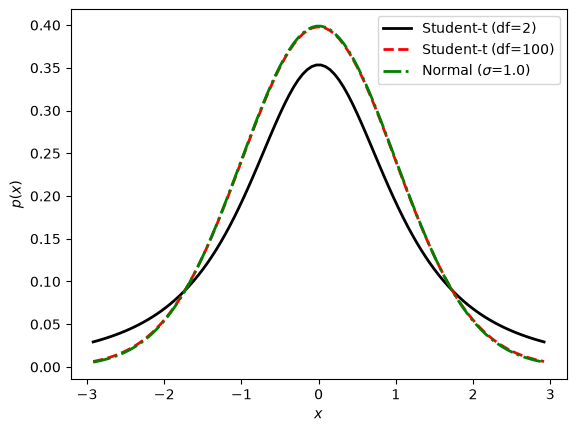
  • Plot the pdf (including at least 90% of the probability mass);

for

  1. A student-t distribution with \(\nu=2\) degrees-of-freedom;

  2. A student-t distribution with \(\nu=100\) degrees-of-freedom;

  3. A standard normal distribution;

in all cases with the mode at 0.0.

Exercise 40.2 (Bivariate pdf)

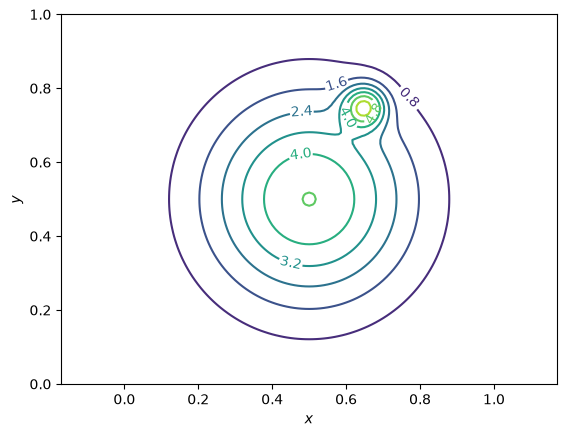
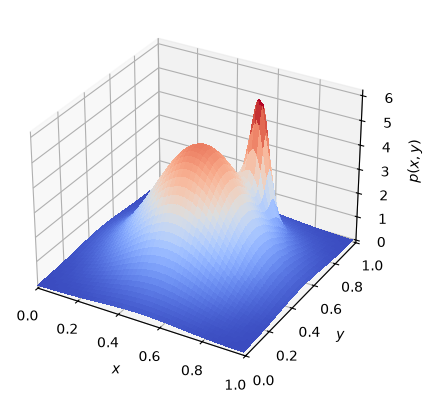
Consider the following (multimodal) bivariate pdf

\[ \p{x,y} = A_1 \exp\left(- \frac{(x-x_1)^2 + (y-y_1)^2}{2\sigma_1^2} \right) + A_2 \exp\left(- \frac{(x-x_2)^2 + (y-y_2)^2}{2\sigma_2^2} \right), \]

with \(A_1=4.82033\), \(x_1=0.5\), \(y_1=0.5\), \(\sigma_1=0.2\), and \(A_2=4.43181\), \(x_2=0.65\), \(y_2=0.75\), \(\sigma_2=0.04\).

Consider the domain \(x,y \in [0,1]\) and use relevant python modules / methods to

  • Plot contour levels of this pdf (useful methods: np.meshgrid and plt.contour);

  • Make a three-dimensional plot of the pdf (useful methods: plt.subplots(subplot_kw={"projection": "3d"}) and plt.plot_surface);

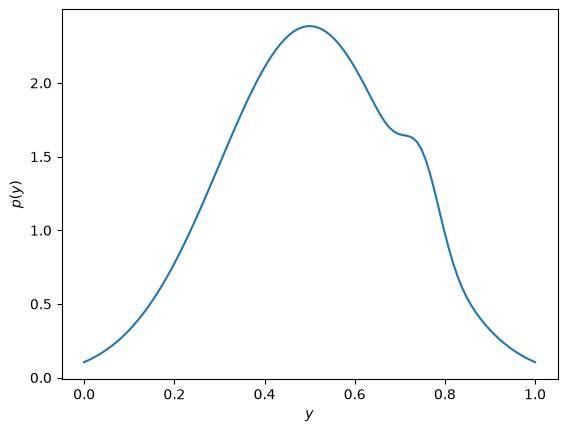
  • Compute and plot the marginal pdf \(\p{y}\) (useful method: scipy.integrate.quad)

Solutions#

Hide code cell content

import scipy.stats as stats
import matplotlib.pyplot as plt
import numpy as np
fig, ax = plt.subplots(1, 1)

# Define a student-t distribution with location=0.0 and scale = 1.0
# and \nu=2 degreefs of freedom 
df=2
my_student_t_rv = stats.t(df, loc=0.0, scale=1.0)

# An appropriate mesh for plotting
x = np.linspace(my_student_t_rv.ppf(0.05),my_student_t_rv.ppf(0.95), 100)

print(f'=========\n Student-t distribution df={df}\n=========')
# Extract and print the mean and variance
print(f'The mean is {my_student_t_rv.mean():3.1f}')
print(f'The variance is {my_student_t_rv.var():3.1f}')

# The 68% credible interval (approximately one sigma)
(min68,max68) = my_student_t_rv.interval(0.68)
print(f'The 68% credible interval is [{min68:4.2f},{max68:4.2f}]')

# Draw random samples.
print(my_student_t_rv.rvs(size=5))
# Plot
ax.plot(x, my_student_t_rv.pdf(x), 'k-', lw=2, label=f'Student-t (df={df})')

# Define a student-t distribution with location=0.0 and scale = 1.0
# and \nu=100 degreefs of freedom 
df=100
my_student_t_rv = stats.t(df, loc=0.0, scale=1.0)

print(f'=========\n Student-t distribution df={df}\n=========')
# Extract and print the mean and variance
print(f'The mean is {my_student_t_rv.mean():3.1f}')
print(f'The variance is {my_student_t_rv.var():3.1f}')

# The 68% credible interval (approximately one sigma)
(min68,max68) = my_student_t_rv.interval(0.68)
print(f'The 68% credible interval is [{min68:4.2f},{max68:4.2f}]')

# Draw random samples.
print(my_student_t_rv.rvs(size=5))
# Plot
ax.plot(x, my_student_t_rv.pdf(x), 'r--', lw=2, label=f'Student-t (df={df})')

# Define a normal distribution with location=0.0 and scale = 1.0
scale = 1.0
my_normal_rv = stats.norm(loc=0.0, scale=scale)

print(f'=========\n Normal distribution (sigma = {scale:3.1f})\n=========')
# Extract and print the mean and variance
print(f'The mean is {my_normal_rv.mean():3.1f}')
print(f'The variance is {my_normal_rv.var():3.1f}')

# The 68% credible interval (approximately one sigma)
(min68,max68) = my_normal_rv.interval(0.68)
print(f'The 68% credible interval is [{min68:4.2f},{max68:4.2f}]')

# Draw random samples.
print(my_normal_rv.rvs(size=5))
# Plot
ax.plot(x, my_normal_rv.pdf(x), 'g-.', lw=2, label=fr'Normal ($\sigma$={scale})')
ax.legend(loc='best')
ax.set_xlabel(r'$x$')
ax.set_ylabel(r'$p(x)$');
=========
 Student-t distribution df=2
=========
The mean is 0.0
The variance is inf
The 68% credible interval is [-1.31,1.31]
[-2.22452528 -5.48129769  0.10656564  3.95149027 -0.40276024]
=========
 Student-t distribution df=100
=========
The mean is 0.0
The variance is 1.0
The 68% credible interval is [-1.00,1.00]
[ 0.05424355 -0.35627293  0.47390846 -0.05151771  0.68070388]
=========
 Normal distribution (sigma = 1.0)
=========
The mean is 0.0
The variance is 1.0
The 68% credible interval is [-0.99,0.99]
[-0.29848653 -0.68745332  1.65497762 -1.26022769 -2.27193524]
../../../../_images/f2677cdfeac05022d368ec989eb679785b7daf1b4dee6e4b1036a9775334255b.png

Hide code cell content

import numpy as np
import matplotlib.pyplot as plt
from matplotlib import cm

def pdf(x,y,A1=4.82033,x1=0.5,y1=0.5,sigma1=0.2,\
            A2=4.43181,x2=0.65,y2=0.75,sigma2=0.04):
	return A1*np.exp(-((x-x1)**2 + (y-y1)**2)/(2*sigma1**2)) + \
		A2*np.exp(-((x-x2)**2 + (y-y2)**2)/(2*sigma2**2))

delta = 0.01
x = np.arange(0.0, 1.0, delta)
y = np.arange(0.0, 1.0, delta)
X, Y = np.meshgrid(x, y)
p = pdf(X,Y)

fig, ax = plt.subplots(1, 1)
CS = ax.contour(X, Y, p)
ax.axis('equal')
ax.set_xlim(0.0,1.0)
ax.set_xlabel(r'$x$')
ax.set_ylim(0.0,1.0)
ax.set_ylabel(r'$y$')
ax.clabel(CS, inline=True, fontsize=10)

fig3d, ax3d = plt.subplots(subplot_kw={"projection": "3d"})
# Plot the surface.
surf = ax3d.plot_surface(X, Y, p, cmap=cm.coolwarm,
                       linewidth=0, antialiased=False)
ax3d.set_xlim(0.0,1.0)
ax3d.set_xlabel(r'$x$')
ax3d.set_ylim(0.0,1.0)
ax3d.set_ylabel(r'$y$')
ax3d.set_zlabel(r'$p(x,y)$');

import scipy.integrate as integrate
y = np.linspace(0,1,100)
pdfy=np.zeros_like(y)
for iy,yi in enumerate(y):
	I = integrate.quad(pdf, 0, 1, args=(yi))
	pdfy[iy] = I[0]
fig_pdfy, axy = plt.subplots(1, 1)
axy.plot(y,pdfy)
axy.set_xlabel(r'$y$')
axy.set_ylabel(r'$p(y)$');
Ignoring fixed x limits to fulfill fixed data aspect with adjustable data limits.
../../../../_images/cbf570e9d5a5ab249d3a382dc7d85a7b722ae6a954821fa95226e79f771038ad.png ../../../../_images/342dc34b1288d1dd9683d9e6d9327c71f76af72764f59bd4cbffaf585869a1dc.png ../../../../_images/d883c76fd3d750759b6cc1f43941ca5e8428c1e3d9a889d48616119b9b4decb3.png