
34.3. Example of Bayesian optimization#
Univariate example#
Here there is only one parameter: \(\theta = \{x\}\).
Show code cell source
Hide code cell source
%matplotlib inline
import numpy as np
import scipy as sp
from scipy.stats import multivariate_normal

import matplotlib.pyplot as plt
import seaborn as sns; sns.set_style("darkgrid"); sns.set_context("talk")
# (removed for sklearn version) import GPy
# (removed for sklearn version) import GPyOpt   # This will do the Bayesian optimization

# === Explicit Bayesian Optimization with scikit-learn (no GPy/GPyOpt) ===
# Features:
# - GaussianProcessRegressor with Matern kernel (+ constant + white noise)
# - Acquisition functions: EI, PI, LCB
# - Sequential BO, domain as list of dicts like GPyOpt's domain
# - Plotting for 1D (acquisition & convergence) and basic 2D acquisition heatmap
#
# Usage example (minimization):
#   def f(x): return (x**2).sum()
#   domain = [{'name':'x1','type':'continuous','domain':(-2,2)}]
#   bo = SklearnBO(f, domain, acquisition='EI', random_state=0)
#   bo.run(max_iter=20)
#   print(bo.X_opt, bo.fx_opt)
#
# If your original code used GPyOpt, replace:
#   SklearnBO(...) -> SklearnBO(...)
#   bo.run(max_iter=...)       -> bo.run(max_iter=...)
#   bo.plot_acquisition()                   -> bo.plot_acquisition()
#   bo.plot_convergence()                   -> bo.plot_convergence()

import numpy as np
from dataclasses import dataclass
from typing import List, Dict, Callable, Optional
from scipy.optimize import minimize
from sklearn.gaussian_process import GaussianProcessRegressor
from sklearn.gaussian_process.kernels import Matern, WhiteKernel, ConstantKernel
import matplotlib.pyplot as plt

import warnings
from sklearn.exceptions import ConvergenceWarning
warnings.filterwarnings("ignore", category=ConvergenceWarning)

def _ensure_2d(X):
    X = np.asarray(X, dtype=float)
    if X.ndim == 1:
        return X.reshape(-1, 1)
    return X

def _bounds_from_domain(domain: List[Dict]):
    lows, highs = [], []
    for d in domain:
        a, b = d['domain']
        lows.append(float(a)); highs.append(float(b))
    return np.column_stack([np.array(lows), np.array(highs)])

def _scale01(X, bounds):
    lb = bounds[:,0]; ub = bounds[:,1]
    return (X - lb)/(ub-lb)

def _unscale01(Z, bounds):
    lb = bounds[:,0]; ub = bounds[:,1]
    return Z*(ub-lb) + lb

def _ei(mu, sigma, best, xi=0.01):
    from scipy.stats import norm
    sigma = np.maximum(sigma, 1e-12)
    z = (best - mu - xi)/sigma
    return (best - mu - xi)*norm.cdf(z) + sigma*norm.pdf(z)

def _pi(mu, sigma, best, xi=0.0):
    from scipy.stats import norm
    sigma = np.maximum(sigma, 1e-12)
    z = (best - mu - xi)/sigma
    return norm.cdf(z)

def _lcb(mu, sigma, kappa=2.0):
    return mu - kappa*sigma

# Helper to safely convert anything (float, array, etc.) to a scalar
def _to_scalar(y):
    import numpy as np
    y = np.asarray(y)
    return y.reshape(-1)[0].item()


@dataclass
class _State:
    X: np.ndarray
    Y: np.ndarray
    best_x: np.ndarray
    best_y: float


class SklearnBO:
    def __init__(self, f: Callable, domain: List[Dict], acquisition='EI',
                 normalize_X=True, normalize_y=True, random_state: Optional[int]=None,
                 xi: float=0.01, kappa: float=2.0, initial_samples: int=5):
        self.f = f
        self.domain = domain
        self.bounds = _bounds_from_domain(domain)
        self.d = self.bounds.shape[0]
        self.normalize_X = normalize_X
        self.normalize_y = normalize_y
        self.rs = np.random.RandomState(random_state)
        self.kind = acquisition.upper()
        self.xi = xi
        self.kappa = kappa

        # Tunable knobs
        signal_bounds = (1e-4, 1e6)
        length_scale_bounds = (1e-4, 1e5)
        noise_bounds = (1e-8, 1e-1)   # keep small upper bound to prefer smooth fits
        n_restarts = 15
        alpha_jitter = 1e-12           # extra numerical stability

        kernel = (ConstantKernel(1.0, signal_bounds) *
                  Matern(length_scale=np.ones(self.d), nu=2.5,
                         length_scale_bounds=length_scale_bounds)
                  + WhiteKernel(noise_level=1e-8,
                                noise_level_bounds=noise_bounds))

        self.gp = GaussianProcessRegressor(
            kernel=kernel,
            normalize_y=self.normalize_y,
            n_restarts_optimizer=n_restarts,
            alpha=alpha_jitter,
            random_state=random_state
        )

        self.X = np.empty((0, self.d))
        self.Y = np.empty((0, 1))
        self.history = []
        self._step_dists = []        # ||x_t - x_{t-1}||
        self._mu_at_selected = []    # GP mean at x_t at selection time

        self._add_initial(initial_samples)

    def _sample_uniform(self, n):
        u = self.rs.rand(n, self.d)
        return _unscale01(u, self.bounds)

    def _add_initial(self, n):
        X0 = self._sample_uniform(n)
        Y0 = np.array([_to_scalar(self.f(x.reshape(1, -1))) for x in X0], dtype=float).reshape(-1, 1)
        self.X = np.vstack([self.X, X0])
        self.Y = np.vstack([self.Y, Y0])
        self._update_state()

    def _update_state(self):
        i = np.argmin(self.Y.ravel())
        best_y = self.Y.ravel()[i].item()
        self.state = _State(self.X.copy(), self.Y.copy(), self.X[i].copy(), best_y)

    def _fit(self):
        Z = _scale01(self.X, self.bounds) if self.normalize_X else self.X
        self.gp.fit(Z, self.Y.ravel())
        self._refit_if_at_bounds()   # try widening and refitting if needed

    def _refit_if_at_bounds(self, expand=10.0, max_tries=2):
        """
        If any optimized hyperparameter is at a bound, rebuild a new kernel
        with widened bounds and refit. Works for kernels of the form:
            ConstantKernel * Matern + WhiteKernel
        """
        tries = 0
        while tries < max_tries:
            # Access fitted kernel parts: (Constant*Matern) + White
            ksum   = self.gp.kernel_         # Sum
            kprod  = ksum.k1                  # Product
            kconst = kprod.k1                 # ConstantKernel
            kmat   = kprod.k2                 # Matern
            kwhite = ksum.k2                  # WhiteKernel

            # Current values
            c_val   = float(kconst.constant_value)
            ls_val  = np.asarray(kmat.length_scale)
            nu_val  = kmat.nu
            n_val   = float(kwhite.noise_level)

            # Current bounds (linear space)
            c_low, c_high   = kconst.constant_value_bounds
            ls_low, ls_high = kmat.length_scale_bounds
            n_low, n_high   = kwhite.noise_level_bounds

            # Optimized (log) theta and bounds
            theta  = self.gp.kernel_.theta
            bnds   = np.array([b for b in self.gp.kernel_.bounds])  # in log space

            at_lo  = np.isclose(theta, bnds[:, 0])
            at_hi  = np.isclose(theta, bnds[:, 1])

            if not (at_lo.any() or at_hi.any()):
                break  # nothing at bounds

            # Widen each sub-bound in linear space
            # (simple: divide lowers by expand, multiply uppers by expand)
            c_low2,   c_high2   = c_low/expand,   c_high*expand
            n_low2,   n_high2   = n_low/expand,   n_high*expand
            ls_low2,  ls_high2  = np.asarray(ls_low)/expand, np.asarray(ls_high)*expand

            # Rebuild a fresh kernel with same current values but wider bounds
            new_kernel = (
                ConstantKernel(c_val, (c_low2, c_high2)) *
                Matern(length_scale=ls_val, nu=nu_val,
                       length_scale_bounds=(ls_low2, ls_high2)) +
                WhiteKernel(noise_level=n_val, noise_level_bounds=(n_low2, n_high2))
            )
            # Assign and refit
            self.gp.kernel = new_kernel
            Z = _scale01(self.X, self.bounds) if self.normalize_X else self.X
            self.gp.fit(Z, self.Y.ravel())
            tries += 1


    def _predict(self, Xcand):
        Xcand = _ensure_2d(Xcand)
        Z = _scale01(Xcand, self.bounds) if self.normalize_X else Xcand
        mu, std = self.gp.predict(Z, return_std=True)
        return mu, std

    def _acq(self, mu, std):
        if self.kind in ("EI","EXPECTED_IMPROVEMENT"):
            return _ei(mu, std, self.state.best_y, self.xi)
        if self.kind in ("PI","MPI","PROBABILITY_OF_IMPROVEMENT"):
            return _pi(mu, std, self.state.best_y, self.xi)
        if self.kind in ("LCB","UCB","GP_UCB"):
            # Maximize acquisition: invert LCB for selection
            return -_lcb(mu, std, self.kappa)
        raise ValueError(f"Unknown acquisition: {self.kind}")

    def _suggest(self, n_restarts=25):
        best_val = -np.inf
        best_x = None
        for x0 in self._sample_uniform(n_restarts):
            def obj(x):
                x = np.asarray(x).reshape(1,-1)
                val = self._acq(*self._predict(x)).item()
                return -val  # minimize negative acquisition
            res = minimize(obj, x0=x0, method="L-BFGS-B", bounds=self.bounds)
            val = -res.fun
            if val > best_val:
                best_val = val
                best_x = res.x
        if best_x is None:
            best_x = self._sample_uniform(1).reshape(-1)
        return best_x.reshape(1,-1)

    def run(self, max_iter=20, tol=0.0, verbose=False):
        for it in range(max_iter):
            # Fit model on current data
            self._fit()

            # Suggest next x and record GP mean at that x
            x_next = self._suggest()

            mu_next, std_next = self._predict(x_next)            #  GP mean at selection time
            self._mu_at_selected.append(float(np.asarray(mu_next).ravel()[0]))  #

            # Distance to previous x
            if len(self.X) > 0:
                prev = self.X[-1].reshape(1, -1)
                self._step_dists.append(float(np.linalg.norm(x_next - prev)))
            else:
                self._step_dists.append(np.nan)

            # Evaluate objective
            y_next = _to_scalar(self.f(x_next))
            self.X = np.vstack([self.X, x_next])
            self.Y = np.vstack([self.Y, [[y_next]]])
            self._update_state()

            if verbose:
                print(f"[{it+1:02d}] best={self.state.best_y:.6g}")

            if len(self.history) > 1 and abs(self.history[-1] - self.history[-2]) < tol:
                break

    @property
    def X_opt(self):
        return self.state.best_x

    @property
    def fx_opt(self):
        return self.state.best_y

    def plot_convergence(self):
        import numpy as np
        import matplotlib.pyplot as plt

        # Prefer recorded history; fallback to best-so-far from Y
        vals = []
        if hasattr(self, "history") and len(self.history) > 0:
            vals = list(self.history)
        elif hasattr(self, "Y") and self.Y.size > 0:
            vals = [float(np.asarray(self.Y).ravel().min())]

        if len(vals) == 0:
            print("No history yet. Run at least one iteration, e.g. myBopt.run(max_iter=1).")
            return

        plt.figure(figsize=(6, 3.2))
        plt.plot(vals, marker='o')
        plt.xlabel("Evaluation")
        plt.ylabel("Best-so-far f(x)")
        plt.grid(alpha=0.3)
        plt.title("Convergence")
        plt.show()


    def plot_convergence_gpopt_style(self):
        """Two-panel convergence (GPyOpt style):
           top: distance between consecutive x's
           bottom: GP mean at the selected x_t (at selection time)
        """
        import matplotlib.pyplot as plt
        if not self._step_dists or not self._mu_at_selected:
            print("No history recorded yet. Run at least one iteration.")
            return

        iters = np.arange(1, len(self._step_dists) + 1)

        fig = plt.figure(figsize=(7, 5.2))
        ax1 = fig.add_subplot(2, 1, 1)
        ax1.plot(iters, self._step_dists, marker='o')
        ax1.set_ylabel(r"$\|x_t - x_{t-1}\|$")
        ax1.grid(alpha=0.3)
        ax1.set_title("Convergence diagnostics")

        ax2 = fig.add_subplot(2, 1, 2)
        ax2.plot(iters, self._mu_at_selected, marker='o')
        ax2.set_xlabel("Iteration")
        ax2.set_ylabel(r"GP mean at $x_t$")
        ax2.grid(alpha=0.3)

        fig.tight_layout()
        plt.show()


    def plot_acquisition(self, num=300):
        if self.d == 1:
            self._fit()
            xs = np.linspace(self.bounds[0,0], self.bounds[0,1], num).reshape(-1,1)
            mu, std = self._predict(xs)
            acq = self._acq(mu, std)

            fig = plt.figure(figsize=(9,4.8))
            ax1 = fig.add_subplot(2,1,1)
            ax1.plot(xs, mu, label="GP mean")
            ax1.fill_between(xs.ravel(), mu-2*std, mu+2*std, alpha=0.2, label="±2σ")
            ax1.scatter(self.X[:,0], self.Y.ravel(), s=20, alpha=0.7, label="evals")
            ax1.axvline(self.X_opt[0], ls='--', alpha=0.6, label='x*')
            ax1.legend(bbox_to_anchor=(1.05, 1), loc='upper left', borderaxespad=0.)
            ax1.set_ylabel("f")


            ax2 = fig.add_subplot(2,1,2)
            ax2.plot(xs, acq, label=f"{self.kind} (maximize)")
            ax2.set_xlabel("x"); ax2.set_ylabel("acq")
            ax2.legend(loc='best')
            plt.tight_layout(rect=[0, 0, 0.85, 1])   # leave room on the right for the legend
            plt.show()

        elif self.d == 2:
            # coarse acquisition heatmap
            self._fit()
            n = int(np.sqrt(num))
            x1 = np.linspace(self.bounds[0,0], self.bounds[0,1], n)
            x2 = np.linspace(self.bounds[1,0], self.bounds[1,1], n)
            X1, X2 = np.meshgrid(x1, x2)
            grid = np.c_[X1.ravel(), X2.ravel()]
            mu, std = self._predict(grid)
            acq = self._acq(mu, std).reshape(n, n)
            plt.figure(figsize=(5,4))
            plt.imshow(acq, origin='lower', extent=[x1.min(), x1.max(), x2.min(), x2.max()], aspect='auto')
            plt.colorbar(label="acq")
            plt.scatter(self.X[:,0], self.X[:,1], s=20, c='k', alpha=0.6, label='evals')
            plt.scatter([self.X_opt[0]], [self.X_opt[1]], marker='*', s=120, label='x*')
            plt.xlabel("x1"); plt.ylabel("x2"); plt.legend(loc='best')
            plt.title(f"{self.kind} acquisition (maximize)")
            plt.show()
        else:
            print("plot_acquisition: implemented for 1D and 2D only.")

import numpy as np

def backfill_history(bo):
    """
    Rebuilds the best-so-far history from existing evaluation data.
    Use this if myBopt.history is empty but you already have myBopt.X and myBopt.Y.
    """
    if not hasattr(bo, "Y") or bo.Y.size == 0:
        print("No evaluations yet to backfill from.")
        return

    y = np.asarray(bo.Y).ravel()
    best_so_far = np.minimum.accumulate(y)
    bo.history = [float(v) for v in best_so_far]
    bo._convergence = list(bo.history)
    print(f"Backfilled history with {len(bo.history)} points.")

def _patched_update_state(self):
    import numpy as np
    # pick current best index and value
    idx = int(np.argmin(self.Y.ravel()))
    best_y = float(np.asarray(self.Y).ravel()[idx])
    # set state
    self.state = type("State", (), {})()
    self.state.best_y = best_y
    self.state.best_x = self.X[idx].copy()
    # ensure lists exist
    if not hasattr(self, "history") or self.history is None:
        self.history = []
    if not hasattr(self, "_convergence") or self._convergence is None:
        self._convergence = []
    # append to both (keep in sync with older code paths)
    self.history.append(best_y)
    self._convergence.append(best_y)

# apply patch
SklearnBO._update_state = _patched_update_state
print("SklearnBO._update_state patched to always fill history and _convergence.")


xmin =  0.
xmax =  1.

def Ftrue(x):
    """Example true function, with two local minima in [0,1]."""
    return np.sin(4*np.pi*x) + x**4

# For this problem, it is easy to find a local minimum using with SciPy, but
#  it may not be within [0,1]!

np.random.seed()  # (123)
x0 = np.random.uniform(xmin, xmax)  # pick a random starting guess in [0,1]
result = sp.optimize.minimize(Ftrue, x0)  # use scipy to minimize the function
print(result)

# Plot the function and the minimum that scipy found
X_domain = np.linspace(xmin,xmax,1000)

fig, ax = plt.subplots(1, 1, figsize=(8,6))
ax.plot(X_domain, Ftrue(X_domain))
ax.plot(result.x[0], result.fun, 'ro')
ax.set(xlabel=r'$x$', ylabel=r'$f(x)$');

# parameter bound(s)
bounds = [{'name': 'x_1', 'type': 'continuous', 'domain': (xmin,xmax)}]

# We'll consider two choices for the acquisition function, expectived
#  improvement (EI) and lower confidence bound (LCB)
# my_acquisition= 'EI'
# #my_acquisition= 'LCB'

# # Creates GPyOpt object with the model and aquisition function
# myBopt = SklearnBO(\
#             f=Ftrue,                  # function to optimize
#             initial_design_numdata=1, # Start with two initial data
#             domain=bounds,            # box-constraints of the problem
#             acquisition=my_acquisition, # Selects acquisition type
#             exact_feval = True)
my_acquisition = 'EI'   # or 'LCB', 'PI'
myBopt = SklearnBO(
    f=Ftrue,
    domain=bounds,
    acquisition=my_acquisition,
    initial_samples=4,   # ← was initial_design_numdata
    random_state=0
)  # drop exact_feval

# Run the optimization
np.random.seed()   # (123)
max_iter = 1      # evaluation budget (max_iter=1 means one step at a time)
max_time = 60     # time budget
eps      = 1.e-6  # minimum allowed distance between the last two observations
SklearnBO._update_state patched to always fill history and _convergence.
  message: Optimization terminated successfully.
  success: True
   status: 0
      fun: -0.850346562233117
        x: [-6.190e-01]
      nit: 4
      jac: [ 0.000e+00]
 hess_inv: [[ 6.171e-03]]
     nfev: 26
     njev: 13
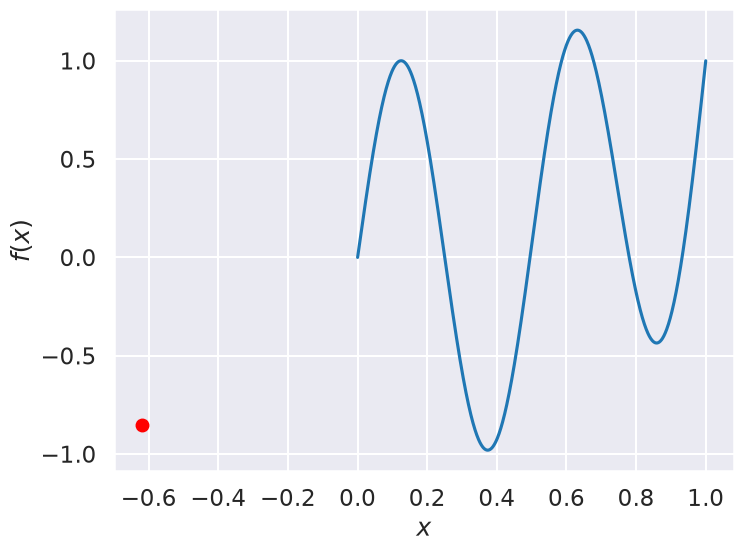
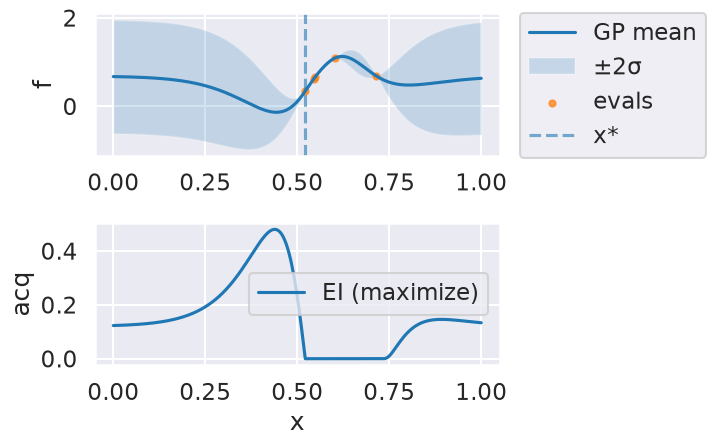
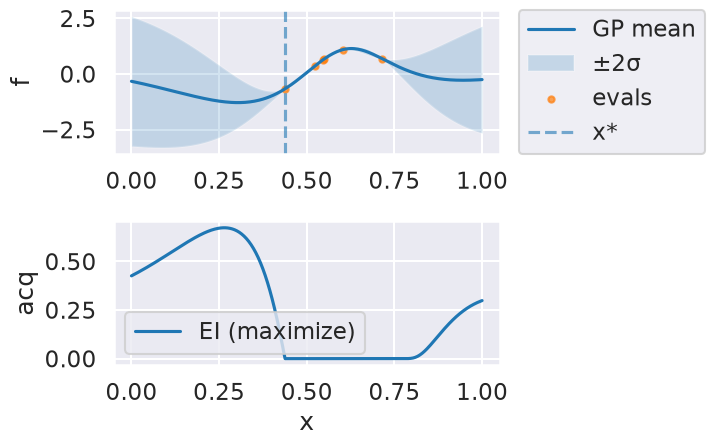
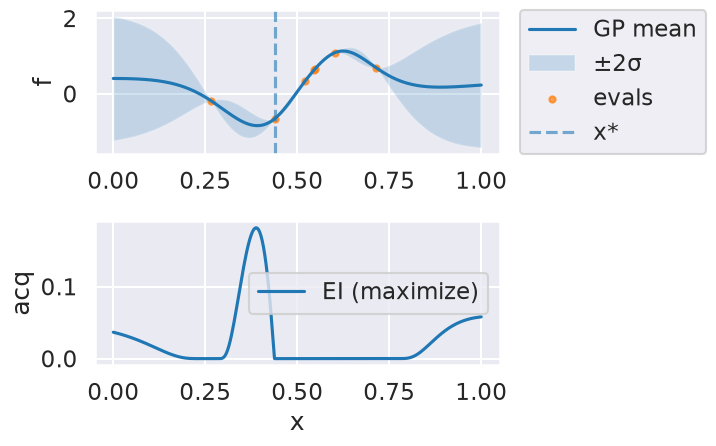
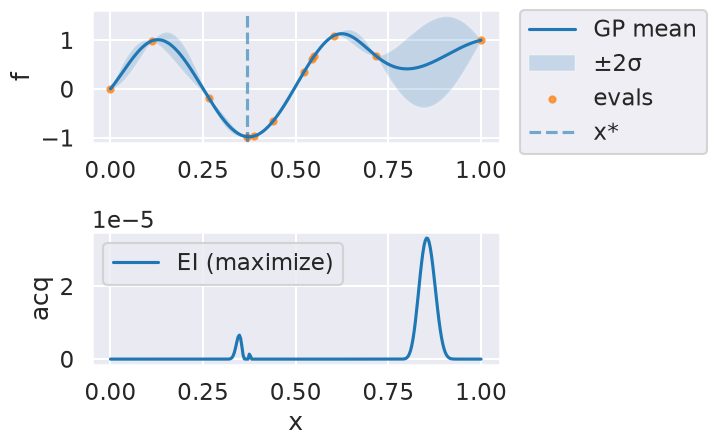
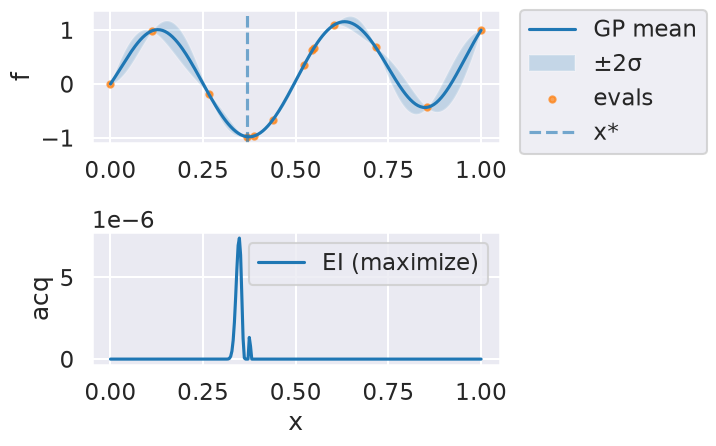
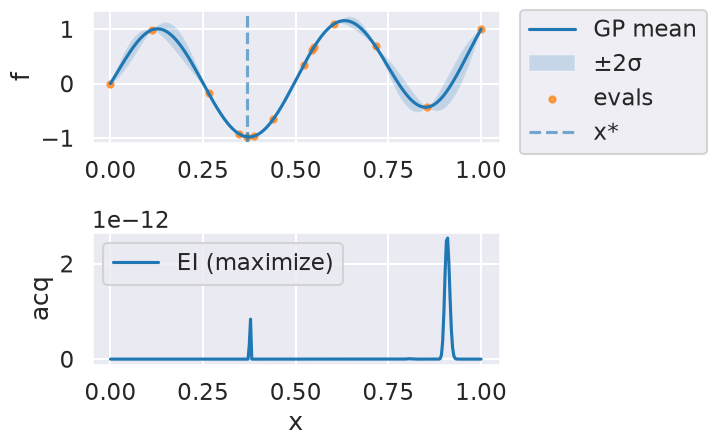
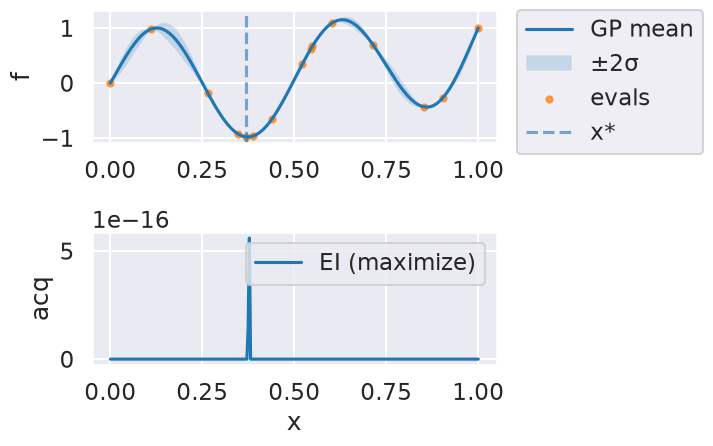
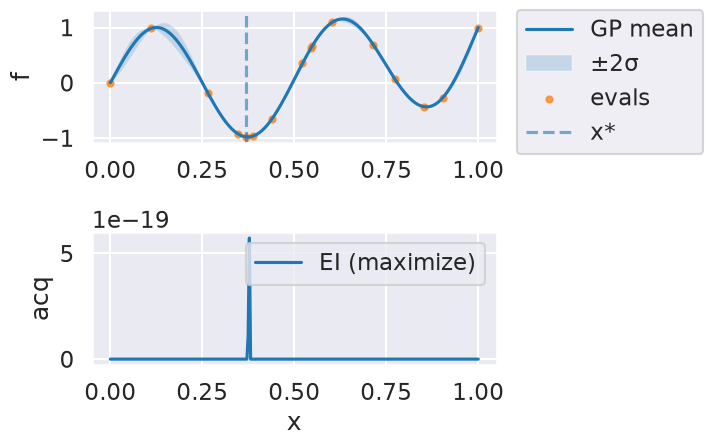
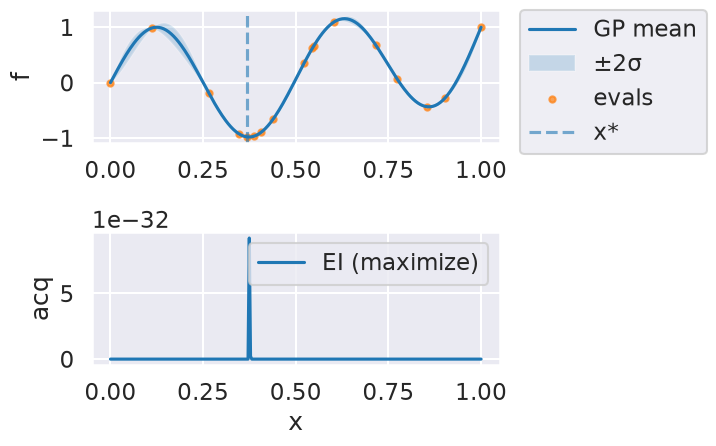
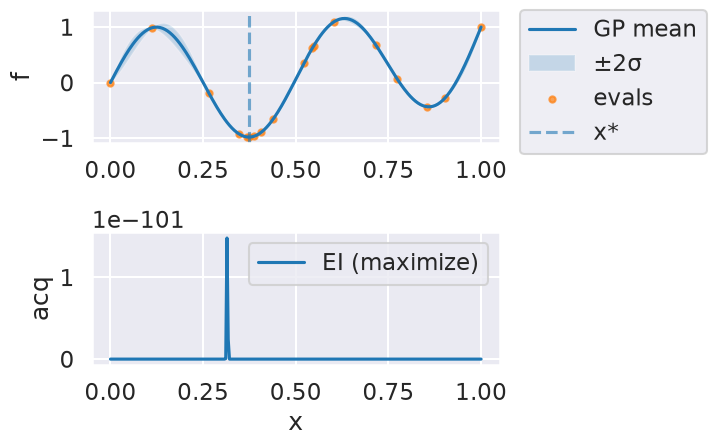
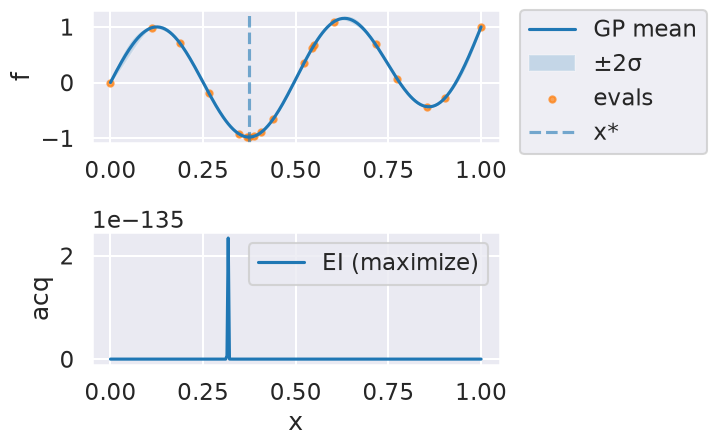
Now we can use the myBopt.run one step at a time (meaning we add one point per iteration), plotting the GP mean (solid black line) and 95% variance (gray line) and the acquisition function in red using plot_acquisition. The maximum of the acquisition function, which will be the choice for \(x\) in the next iteration, is marked by a vertical red line.
What can you tell about the GP used as a surrogate for \(f(x)\)?
Note how the GP is refined (updated) with additional points.
Show code cell source
Hide code cell source
# run for num_iter iterations
num_iter = 15
print('Starting with 4 points')
for i in range(num_iter):
    print("Iteration ", i)
    myBopt.run(max_iter=1, tol=0.0, verbose=False)  # run one BO step per loop
    myBopt.plot_acquisition()
Starting with 4 points
Iteration  0
Iteration 1
Iteration 2
Iteration 3
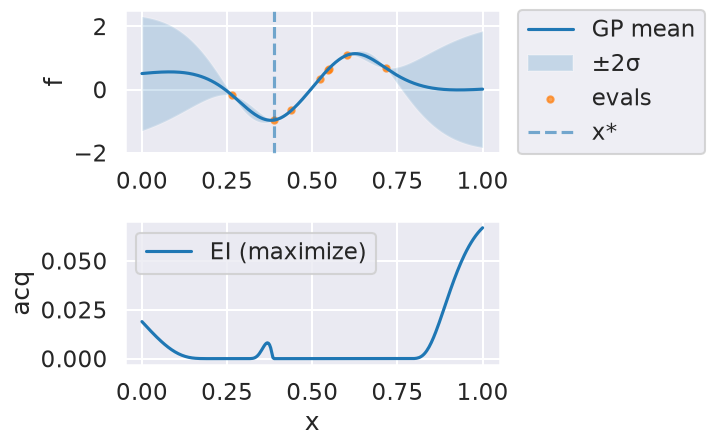
Iteration 4
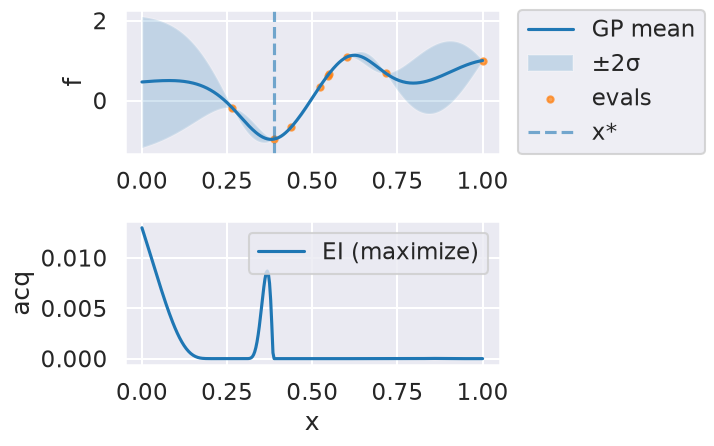
Iteration 5
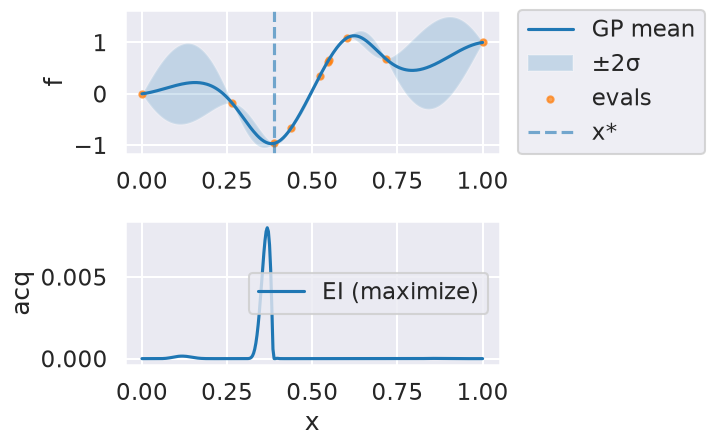
Iteration 6
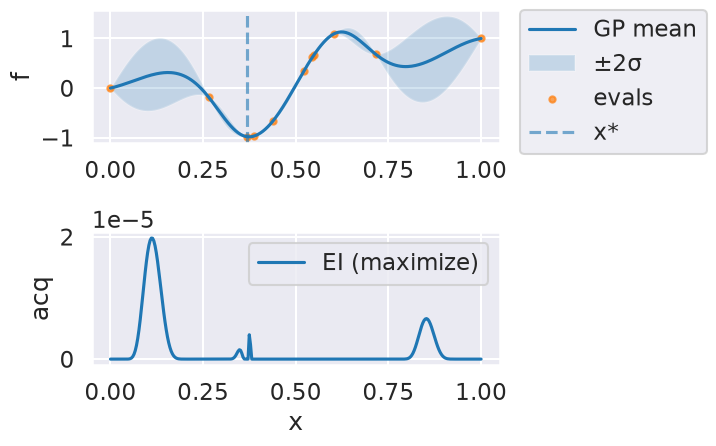
Iteration 7
Iteration 8
Iteration 9
Iteration 10
Iteration 11
Iteration 12
Iteration 13
Iteration 14
Show code cell source
Hide code cell source
print("len(history) =", len(myBopt.history))
print("X shape =", getattr(myBopt, "X", None).shape if hasattr(myBopt, "X") else None)
print("Y shape =", getattr(myBopt, "Y", None).shape if hasattr(myBopt, "Y") else None)

# From the docstring:
# Makes two plots to evaluate the convergence of the model:
#   plot 1: Iterations vs. distance between consecutive selected x's
#   plot 2: Iterations vs. the mean of the current model in the selected sample.

myBopt.plot_convergence()               # best-so-far f(x)
myBopt.plot_convergence_gpopt_style()   # two-panel style like GPyOpt
print(f'Optimal x value = {myBopt.X_opt}')
print(f'Minimized function value = {myBopt.fx_opt:.5f}')
len(history) = 16
X shape = (19, 1)
Y shape = (19, 1)
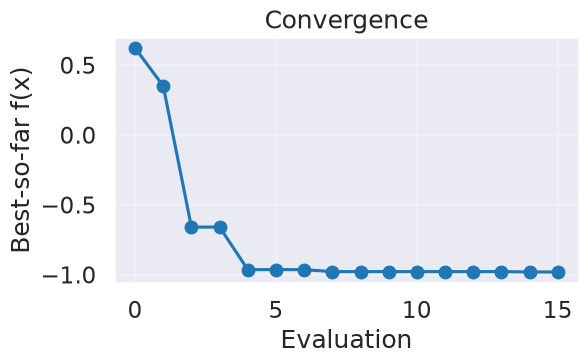
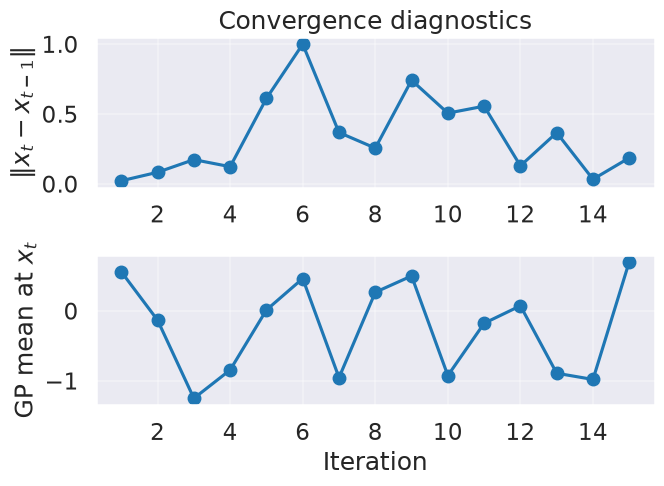
Optimal x value = [0.37381314]
Minimized function value = -0.98036
Bivariate example (two parameters)#
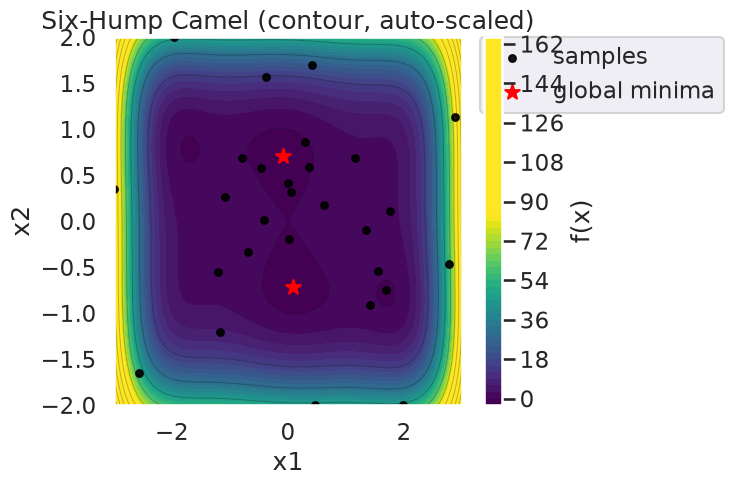
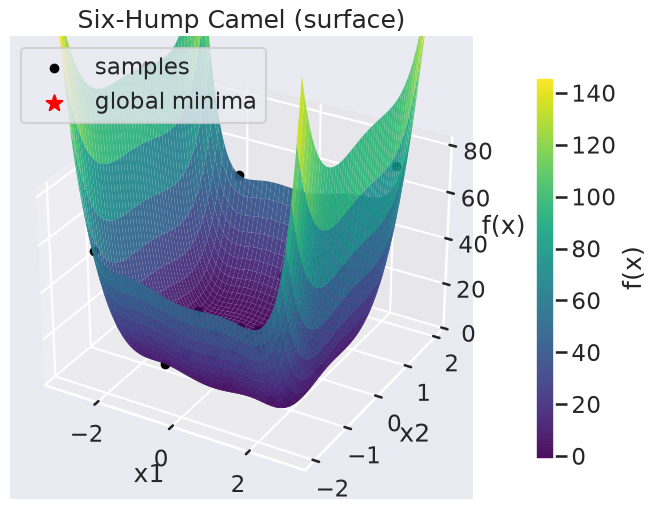
Next, we try a 2-dimensional example. In this case we minimize the Six-hump camel function
in \([−3,3]\), \([−2,2]\). This functions has two global minimum, at (0.0898, −0.7126) and (−0.0898, 0.7126), with function value -1.0316. The function is already pre-defined in GPyOpt. In this case we generate observations of the function perturbed with white noise of first of sd=0.01 and then sd=0.1.
Show code cell source
Hide code cell source
import numpy as np
import matplotlib.pyplot as plt

class SixHumpCamel:
    """Drop-in replacement for GPyOpt.objective_examples.experiments2d.sixhumpcamel"""

    bounds = [(-3.0, 3.0), (-2.0, 2.0)]

    def __init__(self, sd: float = 0.0, random_state: int | None = None):
        self.sd = float(sd)
        self.rng = np.random.RandomState(random_state)

    @staticmethod
    def _sixhump(xy: np.ndarray) -> np.ndarray:
        xy = np.asarray(xy, dtype=float)
        x, y = xy[..., 0], xy[..., 1]
        return ((4 - 2.1 * x**2 + (x**4)/3.0) * x**2
                + x * y
                + (-4 + 4 * y**2) * y**2)

    def f(self, X):
        X = np.asarray(X, dtype=float)
        if X.ndim == 1:
            val = self._sixhump(X)
            if self.sd > 0:
                val = val + self.sd * self.rng.randn()
            return float(np.asarray(val).reshape(-1)[0])
        else:
            vals = self._sixhump(X).reshape(-1)
            if self.sd > 0:
                vals = vals + self.sd * self.rng.randn(*vals.shape)
            return vals

    def plot(self, num=300, kind='contour', vmin=None, vmax=None,
             clip_quantiles=(0.05, 0.95), overlay=None, show_minima=True,
             cmap='viridis'):
        """
        Visualize the six-hump camel function.

        Parameters
        ----------
        num : int
            Grid resolution (num x num).
        kind : {'contour','surface'}
            Plot type.
        vmin, vmax : float or None
            Color/height limits. If None, set from data quantiles given by clip_quantiles.
        clip_quantiles : (low, high)
            Quantiles in [0,1] used to auto-limit color scale when vmin/vmax not given.
        overlay : None, ndarray, or object with attribute .X
            If ndarray, interpreted as shape (n,2) sample locations to overlay.
            If object has .X (e.g., your SklearnBO instance), those points are overlaid.
        show_minima : bool
            If True, mark the two global minima with red stars.
        cmap : str
            Matplotlib colormap name.
        """
        import numpy as np
        import matplotlib.pyplot as plt

        # Build grid and evaluate
        x1 = np.linspace(self.bounds[0][0], self.bounds[0][1], num)
        x2 = np.linspace(self.bounds[1][0], self.bounds[1][1], num)
        X1, X2 = np.meshgrid(x1, x2)
        X = np.c_[X1.ravel(), X2.ravel()]
        Z = self._sixhump(X).reshape(num, num)

        # Auto color limits if not supplied
        if vmin is None or vmax is None:
            lo, hi = np.percentile(Z, [100*clip_quantiles[0], 100*clip_quantiles[1]])
            if vmin is None: vmin = lo
            if vmax is None: vmax = hi

        # Resolve overlay points
        overlay_pts = None
        if overlay is not None:
            if isinstance(overlay, np.ndarray):
                overlay_pts = np.asarray(overlay, dtype=float).reshape(-1, 2)
            elif hasattr(overlay, "X"):
                overlay_pts = np.asarray(overlay.X, dtype=float).reshape(-1, 2)

        # Known global minima (for reference/teaching)
        mins = np.array([[0.0898, -0.7126], [-0.0898, 0.7126]])

        if kind == 'surface':
            from mpl_toolkits.mplot3d import Axes3D  # noqa: F401
            fig = plt.figure(figsize=(7, 5.5))
            ax = fig.add_subplot(111, projection='3d')
            surf = ax.plot_surface(X1, X2, Z, cmap=cmap, linewidth=0, antialiased=True,
                                   alpha=0.95)
            # keep z-limits aligned with color scaling to emphasize humps
            ax.set_zlim(vmin, vmax)
            fig.colorbar(surf, shrink=0.8, pad=0.1, label='f(x)')
            ax.set_xlabel('x1'); ax.set_ylabel('x2'); ax.set_zlabel('f(x)')
            ax.set_title('Six-Hump Camel (surface)')

            # Overlay samples
            if overlay_pts is not None and overlay_pts.size:
                Zs = self._sixhump(overlay_pts)
                ax.scatter(overlay_pts[:,0], overlay_pts[:,1], Zs, s=30, c='k', depthshade=False, label='samples')

            # Overlay minima
            if show_minima:
                Zm = self._sixhump(mins)
                ax.scatter(mins[:,0], mins[:,1], Zm, marker='*', s=140, c='red', label='global minima')

            if (overlay_pts is not None and overlay_pts.size) or show_minima:
                ax.legend(loc='upper left')

            plt.tight_layout()
            plt.show()
            return

        # Default: contour plot
        fig = plt.figure(figsize=(8.6, 5.2))
        cs = plt.contourf(X1, X2, Z, levels=60, cmap=cmap, vmin=vmin, vmax=vmax)
        plt.colorbar(cs, label='f(x)')
        # light contour lines to give shape
        plt.contour(X1, X2, Z, levels=12, colors='k', alpha=0.25, linewidths=0.7)

        # Overlay samples
        if overlay_pts is not None and overlay_pts.size:
            plt.scatter(overlay_pts[:,0], overlay_pts[:,1], s=24, c='k', label='samples', alpha=0.9)

        # Overlay minima
        if show_minima:
            plt.scatter(mins[:,0], mins[:,1], c='red', marker='*', s=120, label='global minima')

        plt.xlabel('x1'); plt.ylabel('x2')
        plt.title('Six-Hump Camel (contour, auto-scaled)')
        if (overlay_pts is not None and overlay_pts.size) or show_minima:
            # put legend outside to avoid obscuring details
            plt.legend(bbox_to_anchor=(1.05, 1), loc='upper left', borderaxespad=0.)
            plt.tight_layout(rect=[0, 0, 0.85, 1])
        else:
            plt.tight_layout()
        plt.show()

# create the object function (2D example)
f_true = SixHumpCamel(sd=0.0)      # noiseless “true” objective
#f_true.plot()
#f_true.plot(kind='surface', clip_quantiles=(0.05, 0.9))
f_sim  = SixHumpCamel(sd=0.1)      # noisy simulator

bounds = [
    {'name': 'var_1', 'type': 'continuous', 'domain': f_true.bounds[0]},
    {'name': 'var_2', 'type': 'continuous', 'domain': f_true.bounds[1]},
]

# run Bayesian optimization using the explicit sklearn version
myBopt2D = SklearnBO(
    f=f_sim.f,                 # pass the callable
    domain=bounds,
    acquisition='EI',          # or 'LCB', 'PI'
    initial_samples=8,
    random_state=0
)
myBopt2D.run(max_iter=20, tol=0.0, verbose=False)
myBopt2D.plot_acquisition()      # 2D heatmap in our implementation
myBopt2D.plot_convergence()

f_true.plot(overlay=myBopt2D)                      # or overlay=myBopt2D.X
f_true.plot(kind='surface', overlay=myBopt2D.X)

print("X* =", myBopt2D.X_opt, "  f* =", myBopt2D.fx_opt)
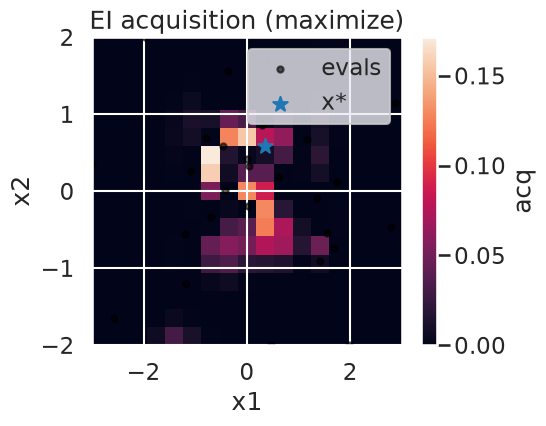
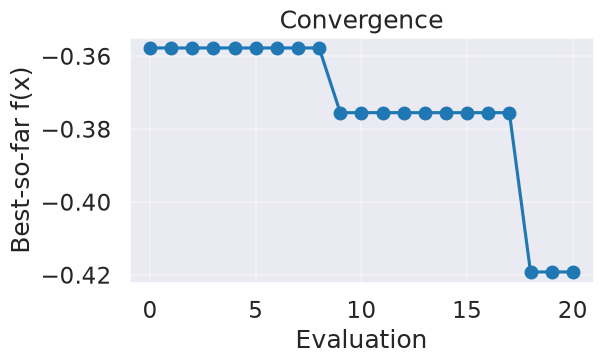
X* = [0.35437334 0.59288601] f* = -0.41917356818901363